
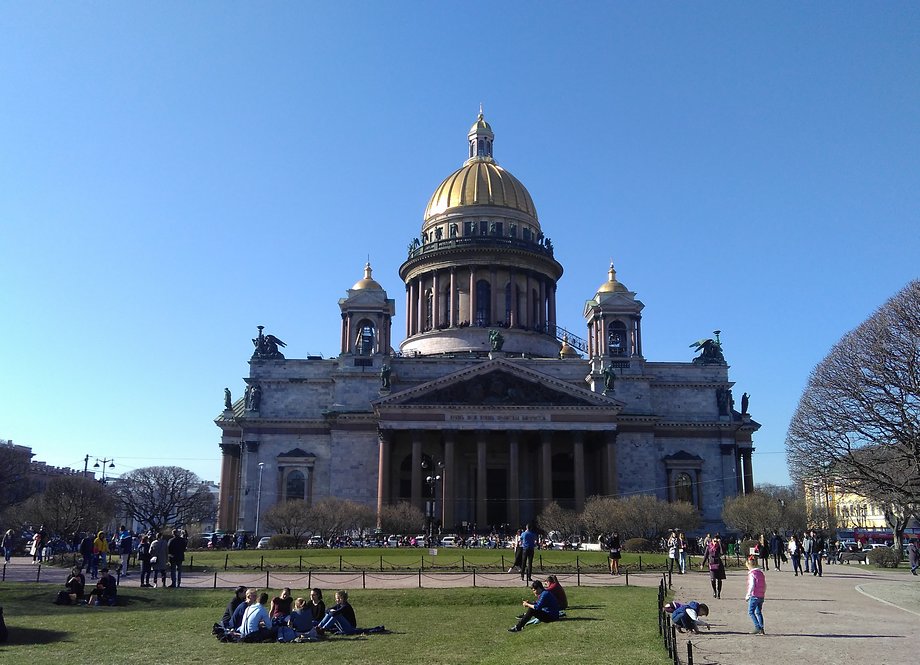
St. Isaac’s Cathedral is one of St. Petersburg’s most famous landmarks. Its distinctive silhouette is considered one of the city’s symbols. Its large, gold-covered dome is visible from many places in St. Petersburg.
A visit to the cathedral is included in the itinerary of almost all tour groups.
The cathedral is located on St. Isaac’s Square, near Palace Square, the Winter Palace, and the banks of the Neva River. An observation deck for tourists is located next to the cathedral’s dome. Currently, a museum is located inside St. Isaac’s Cathedral. Services are also held inside the cathedral.
St. Isaac’s Cathedral is an outstanding example of late classical architecture. This unique structure and architectural landmark is a must-see for tourists visiting St. Petersburg. The building is adorned with 112 monolithic granite columns of varying sizes. The cathedral’s exterior walls are clad in marble, while other materials were also used for the interior.
St. Isaac’s Cathedral is the largest Orthodox church in St. Petersburg. Its official name is the Cathedral of St. Isaac of Dalmatia. Construction of the current cathedral began in 1818, based on designs by the architect Montferrand. The cathedral’s ceremonial consecration took place on May 30, 1858. Emperor Nicholas I personally oversaw the construction.
The cathedral is 101.5 meters high, 111.3 meters long, and 97.6 meters wide. Its interior area is over 4,000 square meters. The dome’s outer diameter is 25.8 meters.
St. Isaac’s Cathedral is the fourth-tallest domed building in the world (101.5 meters), after St. Peter’s Basilica in Rome, St. Paul’s Cathedral in London, and the Cathedral of Santa Maria del Fiore in Florence.
Constructing this grandiose structure was no easy task. Creating a foundation that could support such a large building was difficult. Enormous monolithic granite blocks for the cathedral’s columns were cut from a quarry in Finland (Pyterlahti, between the cities of Hamina and Vyborg, near the village of Virolahti, Finland). They were then transported by sea to St. Petersburg. The granite blocks weighed over 100 tons. Mechanization was unavailable at the time. Most of the work was done by hand or with horses. The museum has an exhibit detailing the history of the cathedral’s construction and the technologies used.
There are also other landmarks near St. Isaac’s Cathedral: the Peter the Great monument (the Bronze Horseman), the Admiralty building, Palace Square, and the Astoria and Angleterre hotels. Palace Square is approximately 600 meters away.
You can find the cathedral’s location on a map of St. Petersburg. Admiralteyskaya is the nearest metro station.